Setup an appointment
Open blocked tubes — before you turn to IVF.
Fallopian tube recanalization is a non-surgical, outpatient procedure that opens blocked fallopian tubes to give you a chance at natural pregnancy — possible in 90% of proximal blockages, and a fraction of the cost of IVF. Performed by Dr. Atabak Allaei, an image-guided specialist patients travel across the West Coast to see.
FTR at a glance
A non-surgical, image-guided procedure to restore natural fertility.
Of proximal blockages can be opened
Conceive if unblocked tubes are normal
More affordable than IVF
Image-guided procedures by our physician
Fallopian tube recanalization (FTR) is a minimally invasive, non-surgical procedure that opens blocked or narrowed fallopian tubes so you have a chance at natural pregnancy. Using X-ray guidance, Dr. Allaei threads a fine catheter and wire through the cervix and uterus into the blocked tube to open it — no surgery, no incisions. It’s possible in 90% of proximal blockages, is recommended by the ASRM before IVF, and costs a fraction of IVF.
Catheter-based, no incisions
ASRM-recommended first step
Of proximal blocks open
20–30× less than IVF
Why fallopian tube recanalization before IVF?
FTR is the least invasive and most affordable option for restoring fertility with blocked tubes — and it should be attempted before pursuing IVF.
Fallopian tube recanalization is the least invasive and most affordable option in restoring fertility in a hopeful mother with blocked fallopian tubes. In Vitro Fertilization (IVF) can cost 20–30 times the cost of fallopian tube recanalization with a similar success rate for pregnancy (see below). This minimally invasive outpatient procedure (described below) should be attempted first before pursuing IVF. If successful, a patient has a chance at a natural pregnancy. However, if the blocked fallopian tube cannot be opened, a patient then knows that their only option is IVF. This outpatient procedure can not only help hopeful mothers understand what their path to pregnancy is but can potentially save tens of thousands of dollars in the process.
Minimally invasive, outpatient — a chance at natural pregnancy
Similar pregnancy success rate, far higher cost & hormonal stimulation
Either way, you gain clarity: if FTR opens the tube, you may conceive naturally. If it can't be opened, you know IVF is your path forward — potentially saving tens of thousands of dollars in the process.
Fallopian tube blockage
Blocked fallopian tubes are one of the most common causes of female infertility — and FTR can open them in about 90% of proximal cases.
Fallopian tube blockage is one of the most common causes of female infertility. The fallopian tubes are very fine tube-like structures that connect the ovaries on either side to the uterus. The eggs from the ovaries normally travel through the fallopian tubes, where they can be met and fertilized by sperm. Sometimes the tubes can become blocked or narrowed, preventing pregnancy. This can happen in one or both fallopian tubes.
Fallopian tube recanalization is a minimally invasive treatment for blocked or narrowed fallopian tubes and much more affordable than IVF. The procedure is possible in 90% of women with proximal tube occlusion (blockage of the fallopian tube near the uterus).1 The American Society for Reproductive Medicine recommends recanalization before attempting more invasive and more expensive fertility treatments like IVF.1 The tubes are recanalized through a procedure called fallopian tube catheterization with selective salpingography.
How is fallopian tube recanalization performed?
It's a non-surgical procedure called selective salpingography, performed under moderate IV sedation.
We can diagnose and treat blocked fallopian tubes with selective salpingography, which is a non-surgical procedure. You will need to stop eating and drinking 8 hours prior. You will be given moderate sedation through an IV to make you comfortable for the procedure and alleviate any anxiety. We start antibiotic prophylaxis (preventive treatment) 2 days before the procedure.
Preparation
Stop eating and drinking 8 hours before; antibiotics start 2 days prior.
Moderate IV sedation
Sedation through an IV keeps you comfortable and relieves any anxiety during the procedure.
Speculum & uterine imaging
Like a pelvic exam, a speculum is placed, a catheter is inserted through the cervix, and dye images the uterine cavity on X-ray.
Open the blockage
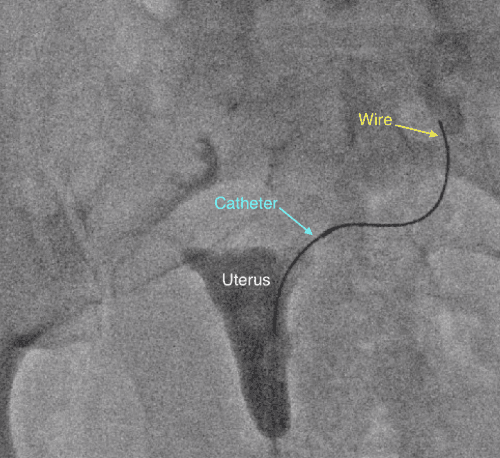
When a blockage is found, a smaller catheter and wire are threaded into the fallopian tube to open it.
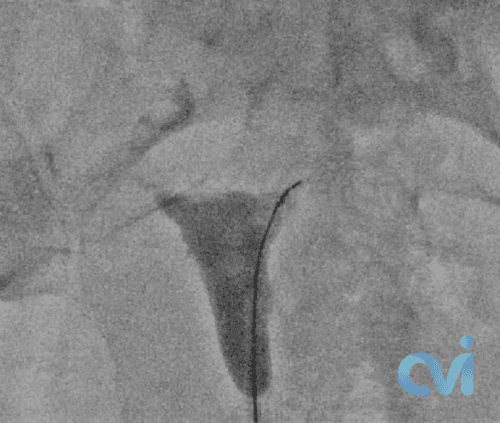
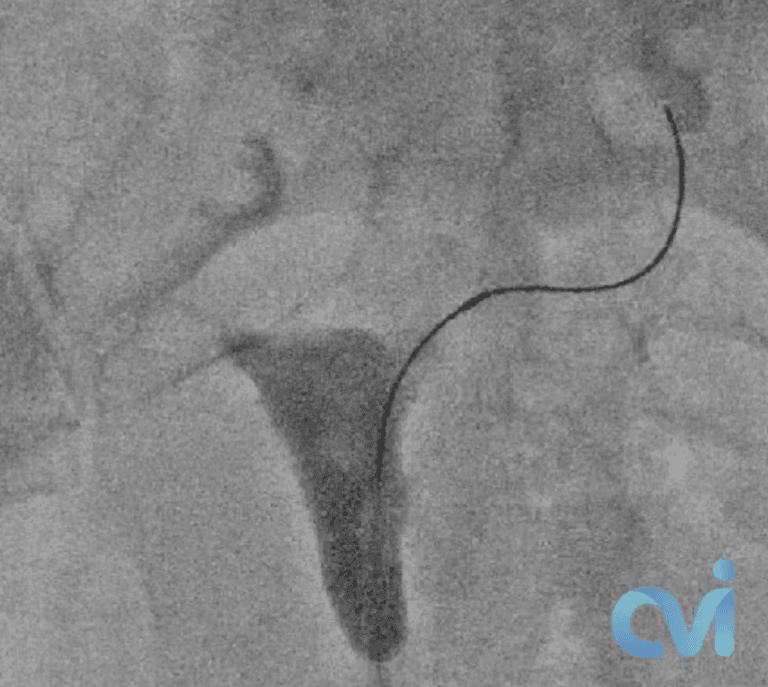
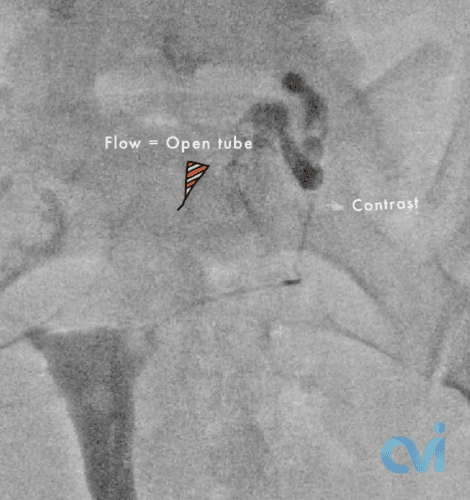
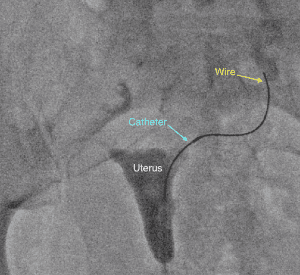
During the procedure, similar to a pelvic exam at your OBGYN, you lay on your back and a speculum is placed into the vagina. Then a small catheter is inserted through the cervix and a contrast agent, or dye, is injected into the uterus so an X-ray image of the uterine cavity can be obtained. When a fallopian tube blockage is identified, another smaller catheter and wire are threaded into the fallopian tube to open the blockage.
Our outpatient center sees patients that travel from not only the Los Angeles area but throughout the West Coast seeking our specialist’s expertise. The procedure is performed by our board-certified interventional radiologist, an expert in image-guided procedures using X-rays, tiny catheters and other micro-tools. What is interventional radiology? This is the only specialty in medicine specifically trained to perform image-guided minimally invasive procedures. Read more here.
What causes tubal blockage?
The most common cause is pelvic inflammatory disease (PID) — often from infection — which leaves scar tissue that blocks the fine, 1 mm-wide tubes.
As noted, the fallopian tubes are fine, tube-like structures. They are about 7–9 cm long and 1 mm in diameter.1 Because of their fine size, the fallopian tubes are prone to becoming blocked due to accumulation of debris or scarring following inflammation.
The most common cause of tubal factor infertility is pelvic inflammatory disease (PID). PID is a general term used to describe inflammation of the uterus, fallopian tubes, and sometimes the ovaries. It is generally caused by repeated sexually transmitted infections (STIs) such as chlamydia or gonorrhea (although this is not always the case). If left untreated, scar tissue can build up, leading to the blockage of one or both fallopian tubes, causing infertility. If only one tube is blocked, you may still be able to conceive naturally depending on the health of the ovary on that side.
Other causes of tubal factor infertility include:
- Endometriosis
- Previous ectopic pregnancy
- Previous abdominal surgery
- History of infection caused by miscarriage or abortion
- Previous or current infection with gonorrhea or chlamydia
Although tuberculosis is relatively rare in the Western world, it can also cause infection in the fallopian tubes, as can a ruptured appendix. All of these can cause scar tissue, mucus and debris to build up in the fallopian tubes, which can lead to blockage.
What factors affect pregnancy rates?
Several factors affect pregnancy rates after FTR — including age, type and duration of infertility, and how many tubes are opened.
Age
Type of infertility
Women with secondary infertility are 15 times more likely to conceive than those with primary infertility.2 Primary refers to couples who have not conceived after at least a year of unprotected sex; secondary refers to couples who were previously able to conceive but now cannot.
Duration of infertility
Recanalization is 21 times more likely to succeed if infertility is less than 5 years’ duration compared to longer.
Number of recanalized tubes
Chances of success are higher when both tubes are blocked and recanalized than when only one side is. With one blocked and one good tube, other factors may be contributing to infertility.
History of prior interventions
Women with prior IUD placement, D&C, induced abortion and other such interventions have a higher pregnancy rate following FTR.
Prior successful conception
Women who have had prior successful conception have a higher chance of becoming pregnant after FTR than women who have never been pregnant.
What is the success rate?
The pregnancy rate is high: 6 out of 10 patients can conceive if the unblocked tubes are otherwise normal, and technical success reaches up to 100%.
The pregnancy rate after fallopian tube recanalization is high. Studies show that 6 out of 10 patients can conceive if the unblocked tubes are normal, i.e., there is no underlying tubal disease.
If the blockage is due to debris within the tube, there is a high chance of success. Debris within the tube usually causes blockage of the proximal fallopian tube (near the uterus).
If the tube is scarred down from prior infection or inflammation, there is a lower success rate of opening the blockage. Pelvic inflammatory disease (PID) often causes distal fallopian tube blockage (near the ovary). It’s much simpler to fix a clogged pipe than a broken pipe.
The technical success rate of fallopian tube catheterization is extremely high (up to 100%).2 However, sometimes, tubal re-occlusion occurs, i.e., the fallopian tubes become blocked again. This occurs in 50% of patients who do not conceive by 6 months. Such patients may benefit from a repeat catheter recanalization. Pregnancy can occur after a second or even a third fallopian tube recanalization. It is also worth noting that once the tubes are open, additional fertility treatments may be necessary.
Selective salpingography and fallopian tube recanalization is a safe and effective treatment. Success rates are high in experienced hands with dedicated equipment in the appropriate setting.
A premium practice built for the most delicate work
Superior catheter and wire skill is essential in a procedure as delicate as FTR — and at CVI you're treated by a specialist with 5,000+ image-guided procedures, using only the finest dedicated tools.
Patients travel from across the West Coast for this expertise
Our outpatient center sees patients who travel not only from the Los Angeles area but throughout the West Coast seeking our specialist’s expertise. Dr. Atabak Allaei is a dual board-certified interventional radiologist who has performed over 5,000 image-guided procedures — with experience recanalizing not only fallopian tubes but also blocked veins and arteries. That breadth of catheter-and-wire mastery is exactly what a sub-millimeter procedure like FTR demands, and it’s what gives you the best possible chance at success.
Superior catheter & wire skill
FTR lives or dies on fine catheter and wire control through 1 mm tubes. Our doctor’s 5,000+ procedures across veins and arteries bring a rare depth of that exact skill.
The best tools, no corners cut
A West Coast destination
Physician-performed throughout
The procedure is performed by our board-certified interventional radiologist — the only specialty trained specifically for image-guided, minimally invasive work.
Superior catheter and wire skills are essential in a delicate procedure such as fallopian tube recanalization. Our doctor is an image-guided specialist having performed over 5,000 procedures with experience in not only fallopian tube recanalization but also recanalization of blocked veins and arteries. This wide array of experience brings a unique set of skills to ensure that you have the most successful outcome.
We have a high success rate at CVI not only because our physician is expertly skilled but also because we provide the physician with the best tools needed to open the fallopian tubes. The choice of wires and catheters that are placed through the fallopian tubes are essential to provide you the best chance at success. Unlike other clinics, you can rest assured that at CVI we do not cut corners and only purchase the best and highest quality tools that our specialist requires.
Appointments are available via an online video telehealth platform or in person at one of the offices in Los Angeles, Orange County or San Diego, depending on the doctor’s availability. Contact us today. Why should you choose us? Read here.
Fallopian tube recanalization cost
FTR is a cash-pay procedure at our office — but at a fraction of the cost of IVF, which can run 20–30 times higher.
We do not accept insurance for the FTR procedure. Please contact our office for the current charges. Even so, fallopian tube recanalization remains far more affordable than IVF — which can cost 20–30 times as much for a similar pregnancy success rate.
Request an Appointment
Please note that although we strive to protect and secure our online communications, and use the security measures detailed in our Privacy Policy to protect your information, no data transmitted over the Internet can be guaranteed to be completely secure and no security measures are perfect or impenetrable. If you would like to transmit sensitive information to us, please contact us, without including the sensitive information, to arrange a more secure means of communication. By submitting this form you consent to receive text messages from CVI at the number provided. Msg & data rates may apply. Msg frequency varies. Unsubscribe at any time by replying STOP.
Who performs your fallopian tube recanalization?
At California Vascular & Interventional, your recanalization is performed by Dr. Atabak Allaei — by the physician, with the sub-millimeter catheter precision this procedure demands. His experience spans not just fallopian tubes but the recanalization of blocked veins and arteries, a breadth of image-guided expertise that few fertility-focused providers can match, and the reason patients travel across the West Coast to be treated here.
Atabak Allaei, MD
Dual board-certified in Vascular & Interventional Radiology and Diagnostic Radiology, with more than 5,000 image-guided procedures and deep experience recanalizing fallopian tubes, veins, and arteries. Interventional radiology is the only specialty trained specifically to perform image-guided, minimally invasive procedures.
Fallopian tube recanalization: common questions
What is fallopian tube recanalization?
Fallopian tube recanalization (FTR) is a minimally invasive, non-surgical procedure that opens blocked or narrowed fallopian tubes to restore natural fertility. Using X-ray guidance, a catheter and wire are threaded through the cervix and uterus into the blocked tube to open it — no surgery, incisions, or general anesthesia. It is possible in about 90% of women with proximal tube blockage.
Why try fallopian tube recanalization before IVF?
FTR is the least invasive and most affordable option for restoring fertility with blocked tubes. IVF can cost 20–30 times as much, with a similar pregnancy success rate. The American Society for Reproductive Medicine recommends recanalization before more invasive, expensive treatments like IVF. If it succeeds, a natural pregnancy is possible; if the tube cannot be opened, you learn IVF is the remaining path — potentially saving tens of thousands of dollars either way.
What is the success rate of fallopian tube recanalization?
The technical success rate of fallopian tube catheterization is extremely high — up to 100%. Studies show 6 out of 10 patients can conceive if the unblocked tubes are otherwise normal. Success is higher when the blockage is due to debris near the uterus, and lower when the tube is scarred from prior infection. Re-occlusion occurs in about 50% of patients who do not conceive within 6 months and may benefit from a repeat procedure.
How is fallopian tube recanalization performed?
It is a non-surgical procedure called selective salpingography. You receive moderate IV sedation, a speculum is placed similar to a pelvic exam, a catheter is inserted through the cervix, and contrast dye images the uterus. When a blockage is found, a smaller catheter and wire are threaded into the tube to open it.
What causes blocked fallopian tubes?
The most common cause is pelvic inflammatory disease (PID), often from sexually transmitted infections such as chlamydia or gonorrhea, which can leave scar tissue. Other causes include endometriosis, previous ectopic pregnancy, prior abdominal surgery, infection following miscarriage or abortion, and rarely tuberculosis or a ruptured appendix — all of which can leave scar tissue, mucus, and debris that block the tubes.
Is fallopian tube recanalization covered by insurance?
We do not accept insurance for the FTR procedure. Please contact our office for the current charges. Even as a cash-pay procedure, FTR is far more affordable than IVF, which can cost 20–30 times as much.
Who is a good candidate for fallopian tube recanalization?
FTR is a good first-line option for patients who are unwilling to undertake the emotional stress and expense of IVF, those who do not wish to receive hormonal stimulation, or those who are not good candidates for IVF — for example, due to advanced maternal age. Chances of conception are higher in women under 35, with shorter duration of infertility, and when both tubes are recanalized.
References:
- Thurmond AS. Fallopian tube catheterization. Semin Intervent Radiol. 2008;25(4):425-431. doi:10.1055/s-0028-1102995 Available online. Accessed on August 30, 2020. https://www.ncbi.nlm.nih.gov/pmc/articles/PMC3036530/
- Al-Omari MH, Obeidat N, Elheis M, Khasawneh RA, Gharaibeh MM. Factors Affecting Pregnancy Rate Following Fallopian Tube Recanalization in Women with Proximal Fallopian Tube Obstruction. J Clin Med. 2018;7(5):110. Published 2018 May 10. doi:10.3390/jcm7050110 Available online. Accessed on August 30, 2020. https://www.ncbi.nlm.nih.gov/pmc/articles/PMC5977149/
- Al-Omari M, Al-Mnayyis A, Obeidat N, et al. Fallopian tube recanalisation using dedicated radiographic tubal assessment set in angiography suite. J Med Imaging Radiat Oncol. 2014;58(4):415-421. doi:10.1111/1754-9485.12169 Available online. Accessed on August 30, 2020. https://pubmed.ncbi.nlm.nih.gov/24592879/
- Papaioannou S, Afnan M, Girling AJ, et al. Long-term fertility prognosis following selective salpingography and tubal catheterization in women with proximal tubal blockage. Hum Reprod. 2002;17(9):2325-2330. doi:10.1093/humrep/17.9.2325 Available online. Accessed on August 30, 2020.
- Knuttinen MG, Jajko R, Scoccia B. Fluoroscopic tubal recanalization in tubal factor related infertility. Semin Intervent Radiol. 2014;31(3):269-271. doi:10.1055/s-0034-1382797 Available online. Accessed on August 30, 2020. https://www.ncbi.nlm.nih.gov/pmc/articles/PMC4139428/
The above information explains what is involved and the possible risks. It is not meant to be a substitute for informed discussion between you and your doctor, but can act as a starting point for such a discussion.
Related treatments
HSG Tube Test
Lipiodol Tube Flushing
Uterine Fibroids (UFE)
Pelvic Congestion Syndrome
All Women's Health
Meet Our Specialist
Take the first step toward natural pregnancy
If blocked tubes are standing between you and pregnancy, recanalization may open them — and answer the question of your path forward — before you commit to IVF. Request a consultation with Dr. Allaei. Telehealth and in-person visits available across Los Angeles, Orange County and San Diego.